
Is My Oak Tree Dying?
Is my oak or elm tree dying? Learn the fall warning signs of oak wilt and Dutch elm disease near Lake Minnetonka, what to do now, and what to do before winter.

4.7 OUT OF 5 STARS
Trusted by homeowners
across the twin cities
As reported in July, the two-lined chestnut borer is taking a toll on oaks across Edina and surrounding Twin Cities communities. In Deephaven, Greenwood, and Minnetonka, where mature oaks and elms are part of the landscape, borers, oak wilt, and soil stress can all leave a tree thinning or browning, which can have you wondering: Is my oak tree dying? The answer depends on the cause.
Red oaks with oak wilt die one to three months after symptoms develop, while some stressed oaks stabilize and live for years with a dead top. An early assessment of the cause decides whether you can plan dormant-season work or need to act quickly.
Key Takeaways
- Thinning canopy and edge dieback deserve a closer look, but they do not confirm that an oak is dying.
- A red oak that drops 90% or more of its leaves in one to two months points toward oak wilt, while dead leaves that hang on for months point toward borers or Armillaria.
- Borer tunnels, Armillaria fungus sheets, and brown streaking in elm wood sit under the bark, so they need professional or lab confirmation.
- Drought and compacted soil can stress an oak that looks fine, so a fall assessment should include both.
- Oak pruning waits for the November through March window, and a fall arborist visit gives you time to plan.
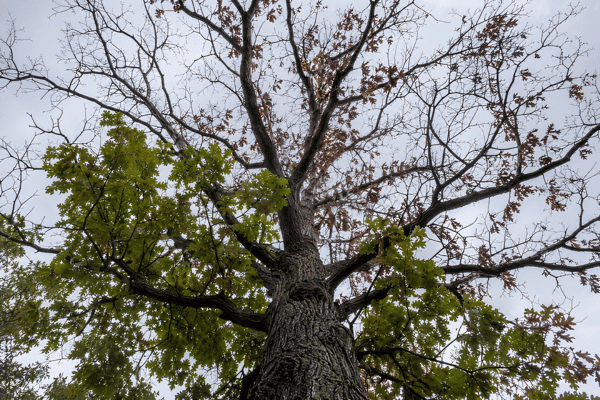
Where the browning starts and how fast the leaves drop help point to the cause.
What Does a Thinning Canopy Mean on an Oak or Elm?
A thinning canopy means the tree’s stressed, but it doesn’t confirm the tree’s dying. Early fall color, leaf scorch, and branch-tip dieback all deserve a closer look, since each can have several causes. Normal fall color is gradual and spreads across the entire crown at about the same time. Browning is limited to a few branches or dead leaves that stay on the tree.
Oak wilt leaf drop and Dutch elm wilting typically show up from late spring through summer, so what you noticed earlier this year is definitely evidence.
Oak Canopy Patterns
The speed and timing of leaf loss help differentiate oak wilt from slower problems such as borers. These clues are the most helpful to compare:
- Red oaks with oak wilt lose 90% or more of their leaves within one to two months, which leaves a carpet of leaves under the tree in summer.
- Red oaks hit by two-lined chestnut borer or Armillaria, a root-rotting fungus, tend to hold their dead leaves for months instead of dropping them, which points away from oak wilt.
The most common trigger of oak decline is severe drought, so think back to recent dry summers when you look at your tree.
Elm Canopy Patterns
From a distance, elm problems look alike, so to tell them apart, look at where the browning starts. These patterns are the most useful:
- With Dutch Elm Disease, leaves turn yellow, wilt or shrivel, turn brown, and then fall on one or more branches in the outer crown.
- With elm yellowing, leaves across the entire canopy turn yellow, droop, and fall within a few weeks.
- With elm leaf beetle, larvae feed on the leaf tissue between the veins, so the whole canopy can look brown from a distance.
Since all three can brown an elm, color by itself doesn’t confirm Dutch Elm Disease.
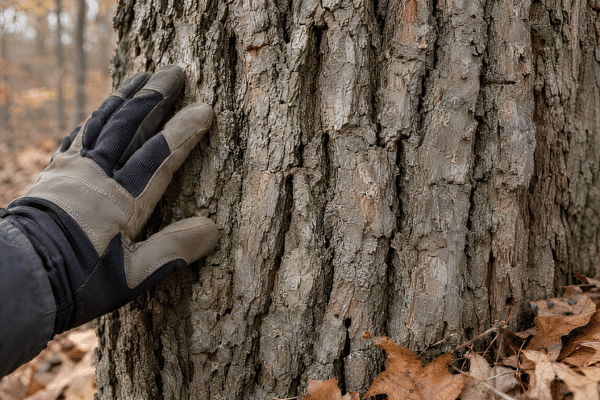
Bark changes can narrow down the cause, but the strongest evidence sits under the bark.
What Do Bark Changes Tell You About an Oak or Elm?
Bark changes can indicate a cause, but they rarely confirm one. From the ground, you can check the trunk and larger limbs for cracks, small holes, and patches of missing bark. The strongest evidence is underneath the bark, and peeling it back should be left to an arborist.
Oak Bark Clues
Since it’s not common for oak bark by itself to give a clear answer, it’s important to understand that anything you see is a clue and not a diagnosis. These signs can help narrow the cause:
- Some red oaks with oak wilt develop subtle bark cracks over fungal growth under the bark.
- Two-lined chestnut borer leaves D-shaped exit holes about 1/8 inch wide on trunks and branches, and its feeding tunnels, called galleries, show only after the bark is removed.
- Exit holes do not prove the borer killed the tree, because borers also attack oaks already killed by oak wilt or Armillaria.
- Armillaria root disease forms white fungal sheets under the bark of the roots and lower trunk.
Elm Bark Clues
Some elm bark clues are visible from the ground, while others are hidden under the bark. The main clues include:
- Woodpecker holes with bark loss are common on elms killed by Dutch elm disease.
- The brown streaking in the sapwood, which is the outer layer of wood just under the bark, shows only after the bark is peeled from a wilted branch.
- With elm yellows, the inner bark of a peeled branch is yellow-brown and smells of wintergreen on American elms.
Does It Matter Where the Dead Wood Sits?
Yes, where the dead wood sits is a helpful clue, especially in red oaks and elms, but it’s not enough on its own. Where the dead wood starts (e.g., toward the top, the outer edge, or a single branch) points to different causes.
Dead Wood on an Oak
In red oaks, dead wood placement helps separate decline from oak wilt. These patterns show up most frequently:
- Decline often starts with edge dieback, and the next year large branches die, usually toward the top of the crown.
- After two years of borer attack, a common pattern is dead, red, and green, with a dead and leafless top, dying leaves still attached in the middle, and green leaves below.
- In white and bur oaks, oak wilt shows up as leaf drop at the canopy edge or from one to a few branches at a time and can look nearly identical to decline, so lab confirmation is the most reliable way to tell them apart.
If lab results point to oak wilt, our guide to oak wilt prevention details how it spreads and how to manage it.
Dead Wood on an Elm
Usually, dead wood on an elm starts off small and spreads from one spot. Watch for changes such as:
- Flagging, which is yellow or brown wilting foliage, spreads down the branch toward the trunk.
- Infected elms may die the same season or over several years, and the disease can pass to neighboring elms through root grafts, which are places where their roots have joined.
- Confirmation means sending live wilting branches to the UMN Plant Disease Clinic.
Why Does a Tree That Looks Fine Sometimes Need More Than a Visual Check?
Early signs of stress are subtle, and many stressors, including soil conditions, sit below ground where a visual check alone can’t reach. Age, crowding from nearby trees, and shade are other stress factors for oaks, specifically.
Soil Health and C-20 Soil Builder
Soil health is part of a fall assessment because compacted, very sandy, shallow, or high-pH soil can make oaks prone to decline, and C-20 Soil Builder is one way to support it. It feeds the soil’s microbial biology instead of the tree directly, which supports long-term root and soil structure health. Results vary by site and tree, and our post on plant health care explains what a program includes. Ask your arborist about C-20 when you request your quote.
Should You Wait Until Spring or Get a Professional Assessment Now?
The better choice is getting a professional assessment now, since an arborist can still read the leaves and plan dormant-season work before spring. Leaf color and wilting stop being clues once the leaves drop, and oak wilt can still move through root grafts to neighboring oaks while you wait. A stressed oak can also drop limbs, so keep people, pets, and vehicles away from large dead branches on your property until an arborist inspects them.
In the meantime, you can do the following:
- Photograph the leaves, trunk, and root flare, which is the base where the trunk widens, and write down anything you noticed earlier this year.
- Hold oak pruning until the dormant window of November 1 through March 31, when the risk of spreading oak wilt is lowest.
Other trees follow different pruning calendars, and our guide to the best time to prune trees in Minnesota breaks them down, species by species. After the assessment, an arborist can schedule dormant-season tree and shrub pruning for any trees that need it.
Frequently Asked Questions About Oak and Elm Trees
Can an oak tree with oak wilt be saved?
It depends on the type of oak. After lab confirmation, a qualified arborist can use a fungicide injection to stop further disease in a white or bur oak for at least two years if less than 30 percent of the crown is affected, but treating symptomatic red oaks is not recommended.
How long can a bur oak live with oak wilt?
Bur oaks with oak wilt typically die within one to seven years, while white oaks can take up to 20 years and some may recover. Symptoms may appear on only one or a few branches and then pause until the following year.
How far can oak wilt spread through roots?
In a Twin Cities study, most oak wilt spread through roots occurred within 30 feet, and some trees wilted up to 50 feet from the nearest infected tree. Roots can also connect different oak species, such as pin oaks and bur oaks.
Is fall pruning safe for an oak?
Not completely, since oak wilt risk is low from August through October, but infection can still occur. An arborist should seal any necessary cut right away.
Can drought kill an oak tree?
In extreme cases, an entire oak can die in a single summer, but drought more often weakens the tree, making it vulnerable to borers and Armillaria. When those problems combine, the tree often dies within two to three years.
Can a Dutch elm be saved?
A Dutch elm can sometimes be saved if it is caught early, because infected branches can be pruned out and fungicide injections can protect the tree from infection by elm bark beetles. Trees with many infected branches should be taken down.
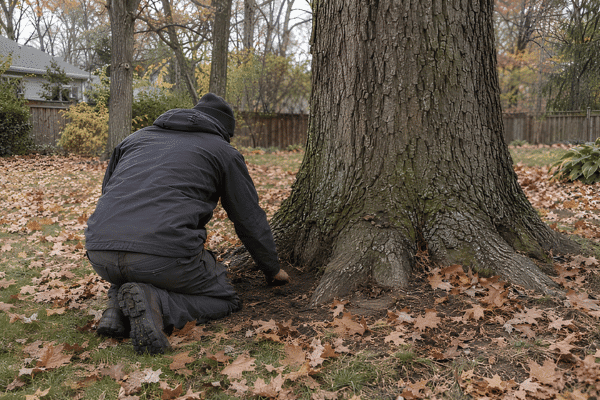
Photos of the leaves, trunk, and root flare give your arborist a head start before the visit.
Have Ostvig Tree Care Look at Your Tree This Fall
Have an ISA Certified Arborist from Ostvig Tree Care assess your tree this fall, since the visit can show whether the tree can be saved or whether winter tree removal is the safer plan. Request a quote online today to get started.
Categories

Jim Ostvig
Few people know Minnesota trees like Jim Ostvig. As an ISA Certified Arborist and former owner of Ostvig Tree Care, he has built a career around providing practical, science-based recommendations that put the long-term health of trees first.
Related Posts
Jim Ostvig | August 14, 2026 | Tree Care Tips
Plant Health Care Programs: What’s Included & Why You Should Enroll
Plant health care keeps trees healthy for years. Discover what's included in a PHC program, why they save money compared to removal, and how to get started.
Jim Ostvig | August 14, 2026 | Seasonal Tree Care, Tree Care Tips
Best Time to Prune Trees in Minnesota (And When to Avoid)
Discover the best seasons for tree pruning in Minnesota. Learn why winter is best for most trees, plus species-specific exceptions and disease risks to avoid.
Jim Ostvig | August 14, 2026 | Tree Pests and Diseases
Oak Wilt Prevention: Minnesota’s Year-Round Seasonal Guide
Worried about oak wilt? Learn when it spreads, how to recognize symptoms, and the best times to prune, treat, and protect Lake Minnetonka oak trees.
Have a Question We Haven't Covered?
Our ISA Certified Arborists are always happy to help. Reach out for a free consultation, or explore more articles in the Learning Center.